

To get your adventure off to a good start
First of all
Basic security
Little Cocon is a baby carrier and has been designed to support you in the natural carrying of your child, from birth to early childhood.
Even though Little Cocon allows the adult carrier to free their hands, we recommend that you always be vigilant and remain in control of the carrying. Maintain control by holding one hand or the front of your arm against your child.
We remind you, as with any means of carrying, to be careful to ensure that your child is always in a position that allows good oxygenation. Your child must always be able to breathe properly regardless of their position and age.
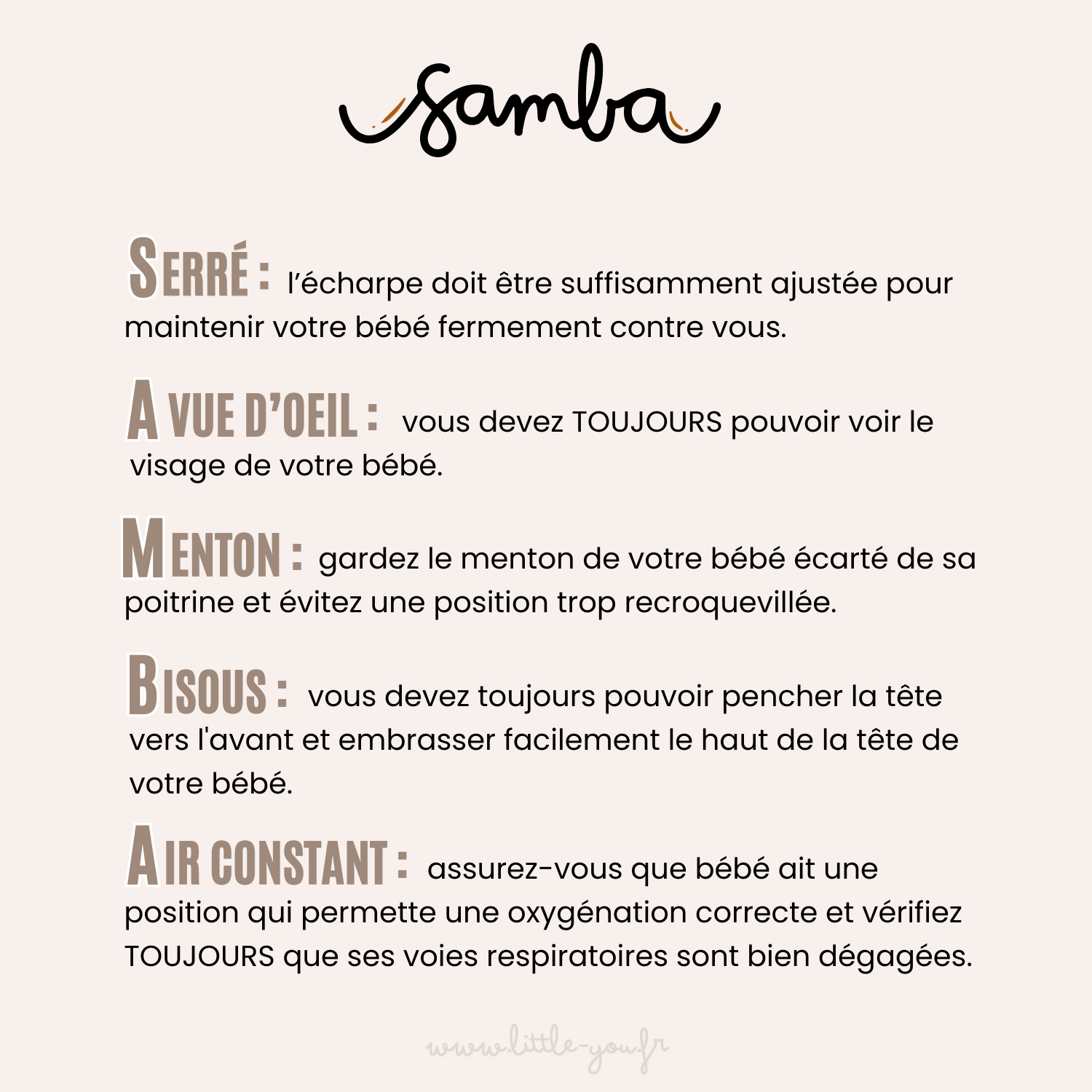
FOR BABY'S SAFETY, ADOPT SAMBA!
SAMBA is an acronym that stands for "Tight, Visible, Chin, Kisses, Air".
We created it so that all parents carrying their child (in Little Cocon or any other means of carrying!) have an easy mnemonic device to remember the 5 most important rules for safe carrying.
Don't hesitate to share the SAMBA spirit around you 💃🏻
Carrying baby properly or
The Physiology of Carrying
Any parent who is even remotely interested in babywearing has already seen or heard the term "physiological" babywearing. But what does that actually mean?
A so-called physiological carrying simply means that it respects the natural posture and comfort of the child. Let's see below how to carry your baby physiologically
⎯ 01
Newborn & Infant: Fetal Position
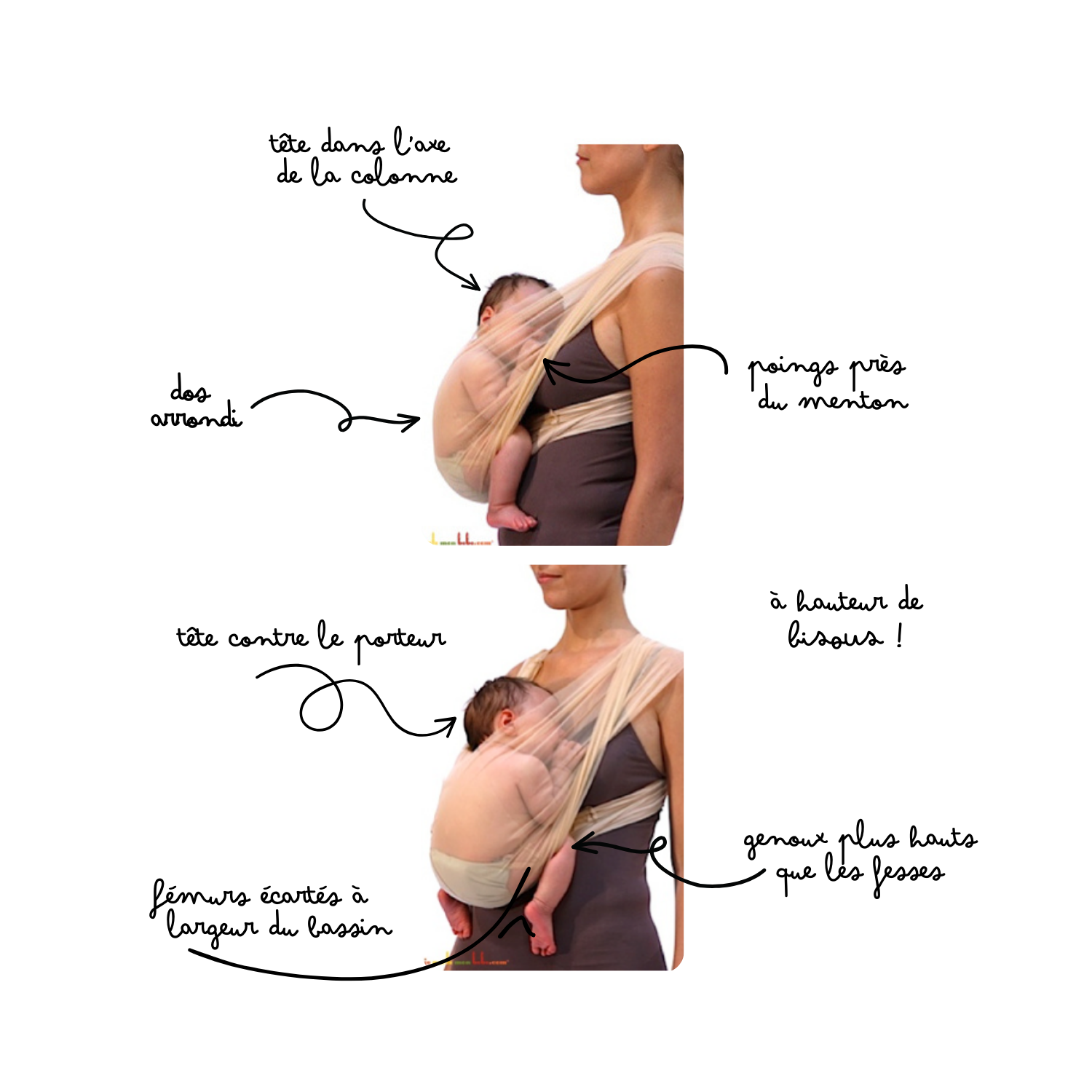
As the name suggests, the fetal position is none other than the position in which the baby developed in the uterus during pregnancy.
For the baby to be in the fetal position, we want:
- His airways are clear
- Her back is completely rounded
- His head rests on the wearer's chest
- His head is in line with the spine (head, spine and pelvis aligned)
- Her knees positioned slightly higher than her buttocks
- His femurs spread pelvic-width apart
- His little fists gathered near his chin
By respecting this carrying position, not only will baby feel incredibly comfortable and soothed as in the cocoon that was his mother's uterus, but he will also be protected against shocks induced by the movements of his carrier.
Finally, don't be afraid of doing it wrong. When we carry a newborn on us, in an upright position on our chest, he automatically adopts this position.
⎯ 02
Baby & Toddler: Position M
As the weeks and months go by, your baby will become more and more energetic.
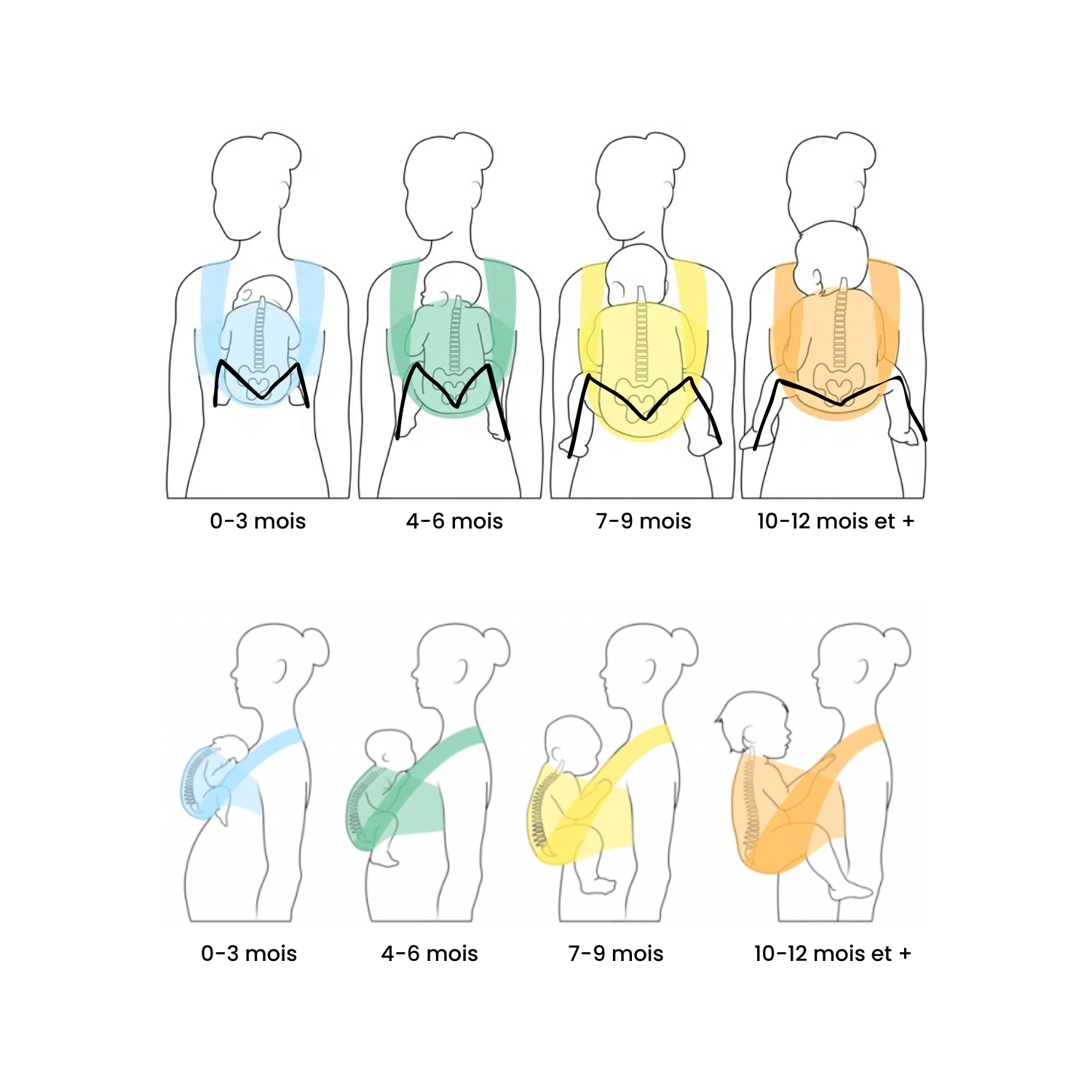
If he is already holding his little feet and holding his head - generally around 3/4 months - it is time to adopt the so-called "M" position.
This position (sometimes called the frog position) is actually the same as the fetal position, with some adjustments to the hip spacing and head and hand position.
The basic rules are the same as in the fetal position:
- Rounded back
- Head in line with the spine
- Knees higher than buttocks
- Fists together
The hip gap will then differ depending on the age of your baby. It should be natural, that is, the same as when you carry your child without a sling.
How do you know if your baby is in the right position?
Seen from behind, we should be able to draw an imaginary “M”, starting from his left foot, going up towards his knee, going back down towards his coccyx, then going back up towards his right knee to end at his right foot.